Lives lived inside our heads

Much of my work lately is centered around choices. How difficult yet liberating it is to make them; how scary yet thrilling it is to leave something behind.

We often miss the real point when we feel our life will shrink when defining things. Life usually expands when it confronts reality. It shrinks inside our heads, where we feed it fantasies we do nothing to fulfill. We stay in a limbo that has the comfort of everything-ness, and the mold of food left out too long. Inside our heads A can coexist with B even if A is ‘staying’ and B is ‘leaving’. And this coexistence is not a peaceful, integrated one. It’s a world where everything can happen only because nothing happens.

Let’s take a step back though. This makes us — yes, “us”, because we all are, at times, people whose only choice is to live inside their heads — seem childish and unreasonable. Why would we ever decide to live surrounded by a blob of things that contradict each other, when choosing is so sensible and mature?

The easy answer is that we aren’t sensible or mature. At least not exclusively. Some of our atoms might be virtuous and reflective, but many other are filled with less resume-friendly tendencies. We will postpone making a choice if it costs us too much effort now, even if it’ll cost us a lot more effort later. We might be a smart species, but we’re not that smart.

The longer answer is that approximately half of our life is lived emotionally, led by beliefs that are not founded on facts, but on needs. This doesn’t make them less real, but it makes us fools when we treat them as facts. We need to believe we can experience the warmth of someone else’s commitment without ever giving ours completely, and our mind is very skilled at making that indisputable. Our reality is exactly this: the one where we desire to give less than what we receive. Because we are defensive, scared, weary, greedy. This is real for us, but it’s not the reality. The reality is that the perfectly well-oiled machine of relationships will ensure that balance will be found eventually, and the commitment we haven’t given will not be returned anymore. It’s not karma, it’s a world of meaningful actions and related consequences. The world of adults, where things exist and people act.

In our world of fantasy, when for all kinds of reasons we withdraw from the world of adults, things half-exist and half-don’t, and we can be soothed by half-truths. We don’t choose because we don’t know why we are choosing. We leave unsaid and undone all those things that before even scaring us, confuse us. Endless questions about what the world will look like after our choice, and the small consolation that we can leave the world as it is, while we dream of possibilities that just because we dream of them, seem real. We need to leave things unchanged, just for a little longer, because we don’t know who we are and what we want, and we live in the illusion that just because we are pausing, the world also is.

If we make choices in this state of mind, even choosing won’t save us from the illusion of everything-ness, from the fantasy of omnipotence. We will walk the A-path while still thinking about B, how amazing it would have been if we made that other choice instead of this one. We miss the point, that there is no real better choice. It’s how we choose, that matters.
The need for time

Amongst the most valuable things I’ve learned with therapy was a better relationship with time. In the past, time for me was always either too little or too much. I was enjoying a night with friends, and thinking “oh, if only it could last longer”, then somehow miss what was happening right in front of my eyes, like I wasn’t there. And the next day, nostalgia. On the other hand, if I had some free time before an appointment I’d want those hours to go fast, so I could just be there, do the thing, be done. Time was never a friend. It reminded me how little control I had on things.

As therapy gradually helped plunging me back into my life — yes, your healers need healing too, that’s how they manage to help you in the first place — a lot of things found a more appropriate place. I was not in “someone else’s shoes”, but I was instead in mine, and from here I could see others more clearly. Time, also, followed this trend. It became a container well suited for what it contained. I didn’t want to control it anymore, so I didn’t need to. It didn’t serve me nor it antagonized me. We both existed, coexisted, and did that as peacefully as possible.

I’m reminded of time as I look for new ways to interact with my professional platforms. How can I coexist peacefully with time when Instagram encourages more and more the contraction of it through summaries and short reels? How can I be spontaneous and genuine if it asks me to post frequently to feed the algorithm? Popularity on social media is necessary to work, but it comes at a cost, not just that of time and money, but that of identity.

I need time to explain how complex this job is.

I need time to elaborate on why I don’t think our goal should be to spot the narcissist in our life — especially because a narcissist always finds another one to bond with.

I need time to discuss on the need for more time in mental health. No 10-session plan to solve your trauma or some months of quick work to put you back on track.

I need time to explore the rooms where my clients take me, to be introduced to their lives, to find a comfortable spot to work together.

I need time to correct the ones who are out there normalizing everything, or pathologizing everything. Not everything is normal, and not everything is a pathology.

I need time to tell you why we need more time.

So I’m coming back to my platform in a different way. I’ll post questions, we can reflect together, but there will be no rush. And I’ll write on this blog, where we can take more time to look at things, and you’re not forced my content on your feed. You can take the time to look for it, and take the time to read it. And who knows, maybe take the time to reply, and say — at length — what you think.

Let’s take more time, shall we?

Online counseling

The Covid crisis, with its consequent lockdown, has increased the number of online services across numerous sectors.

Many psychologists were already working (also) online, but the inability to move led many of them to see clients exclusively online and others to add it to their options.

The same applied to clients: many had already tried it, some had no choice and – whether skeptical or not – searched for an online service.

This increasing need to receive support from a distance moved many to give it a try, and find out the many advantages this form of counseling has.

First of all, the list of psychologists – and therefore possible approach, style, gender, language – becomes potentially limitless.

You live in a small town? You live abroad and would like to use your mother tongue? A great psychologist specialised in anxiety disorders lives two hours away from you and is only available at 8am? You can see them from your couch at home. Or your office at work. Or in your car.

Second, being in a familiar place makes everything easier when we have to open up and embrace our vulnerabilities. 

Being able to sit comfortably, take our shoes off, sit next to a window. The setting is important, but so is comfort.

Third, if you move a lot you can’t change your psychologist every time you change place or skip sessions every time you travel. Counseling needs stability, and sometimes online can be the best means to grant it.

Forth, if the psychologist doesn’t have to rent out a place to offer a service, it will often be cheaper to do it online.

If you are ill, or are hospitalised for long,  have broken your leg… there are endless reasons for considering it.

Life is hectic and not always predictable, and online counseling tries to adapt to those needs, while preserving quality and professionalism.

Integration in counseling

We have seen multiple approaches to psychotherapy and counseling and the difference between them based on their assumptions and goals. Some are more practical and short-term, some investigate deeper aspects, some provide skills, some have a greater interest in the context, some in the individual, and so on.

Then we have seen how the psychologist as a person should be the first factor to consider when predicting the quality and effectiveness of an approach. Without the right attitude (empathy, self-awareness, flexibility, understanding, professionality) on her or his behalf, the therapeutic relationship cannot be built. And without a therapeutic relationship, the skills, expertise, training lose all their worth because there is no connection to apply them to.

Another important factor that fosters improvement and is therapeutic in itself is integration. 
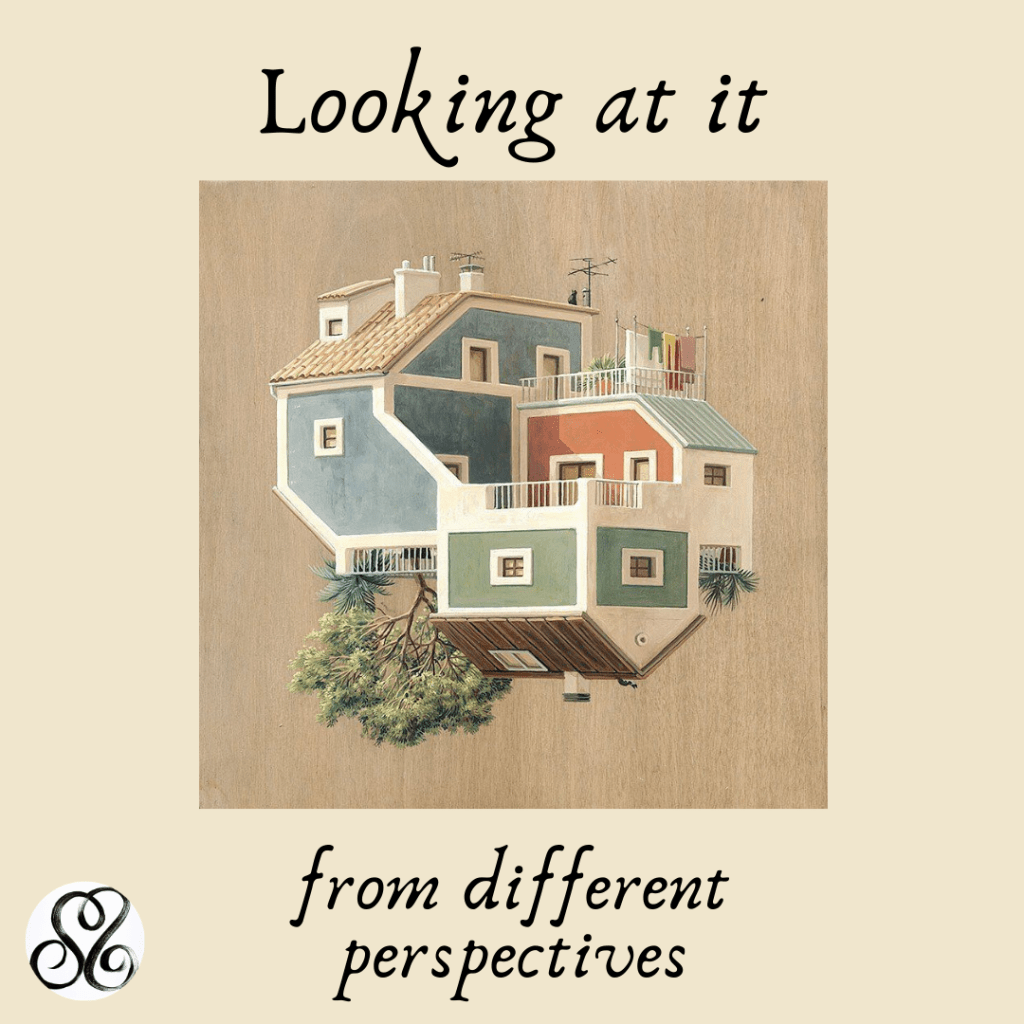
Dogmatism is an enemy of growth, and increasingly more therapists are integrating approaches because they are opening up to the possibility that there are several truths and equally many ways to look at the world, and each one holds some strengths. Every perspective is shedding light on one side of the issue.
Looking at just one side is missing some parts.

Let’s assume a client comes with anxiety.
It will be vital to ask what they are anxious about.
It will be necessary to ask where it started, what it’s triggered by, how it feels in the body and what it’s represented by.
It can be helpful to investigate the client’s past, possible traumas, desires and fears.
It will be also important to understand that they will have to manage it day-by-day and perhaps suggest some mindfulness to learn to stay in the present moment.
Relationships might have to be included in the in picture, to have a broader idea of the client’s life and interactions. If the client was raised to be perfect, then that anxiety could also have connections to that.
It will be relevant to ask if this anxiety is a pattern, or comes up in specific occasions.
And lastly, the client might have to accept at least a part of their anxious tendency, befriend that anxiety and start to learn its triggers without just fighting it.

This is what integration looks like.

The importance of therapeutic relationship

After decades of different schools trying to prove they had the best and most effective theories, increasingly more articles are coming up on the effectiveness of other variables than just the approach.

And increasingly more schools are integrating rather than separating, because it is clear there are things that work across approaches. One of them (one of the most important actually!) is the therapeutic relationship. And there are some factors that seem to mediate this relationship and improve its quality.

On the relational level, the therapist is expected to have empathy, offered with humility. The therapist should be in touch with their experience and their attachment style, so they don’t project that on the client. For some clients it can be important, in order to feel a connection with their therapist, to choose someone who has faced similar social struggles (could mean belonging to the same community, sharing the same race/gender). The flexibility of the therapist is also of fundamental importance: being a professional does not mean having all the right answers, or teaching something. There is always room for improvement and admitting mistakes.

Kindness strengthens this bond, as well as respect and warmth.

Therapists are not guides, teachers, or flawless people. With constant and passionate dedication, they build their expertise, treat the relationship with their clients with care and attention and provide presence. Before following any method or approach, they are people who believe there is growth in insight, awareness, listening to one’s emotions and needs, feeling a sense of efficacy and self-worth. First, they learn that for themselves. And then, they can help someone else find their way.

Much of the healing is the relationship.

Assumptions, goals and methods of different approaches

— Italiano sotto —

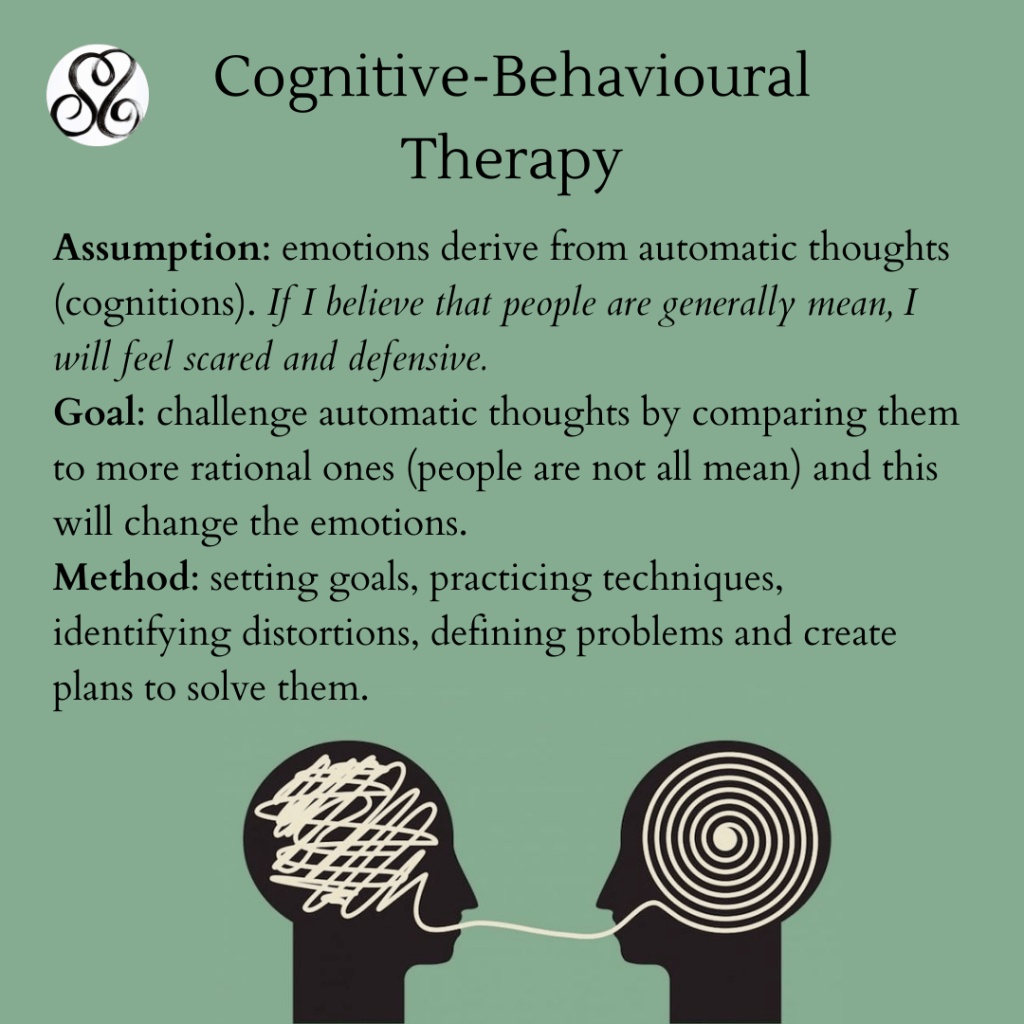
Cognitive-Behavioural Therapy

Assumption: emotions derive from automatic thoughts (cognitions).
If I believe that people are generally mean, I will feel scared and defensive.
Goal: challenge automatic thoughts by comparing them to more rational ones (people are not all mean) and this will change the emotions.
Method: setting goals, practicing techniques, identifying distortions, defining problems and create plans to solve them.

Psychodynamic Psychotherapy

Assumption: we have unconscious feelings that work underneath our consciousness and create tension.
If I am afraid of adulthood and its implications, but I cannot handle this feeling, I will repress this realisation, but this will still affect my mental state.
Goal: uncover unconscious desires and fears.
Method: unveiling main defense mechanisms, working with dreams, transference (what the client projects on the therapist that comes from elsewhere) and investigating not only the present, but also the past.

Schema Therapy

Assumption: people repeat certain patterns (schemas) that start mostly during childhood.
If I have the schema “I am a failure” due to not having my needs of recognition and value met, I might interpret reality through those lenses.
Goal: help the client address these needs, embrace them and fulfil them.
Method: identifying main schemas and modes. Modes are temporary mindsets that define how you feel and cope in a certain moment: you could be in ‘child mode’ when you feel vulnerable, or in ‘parent mode’ when you criticise yourself.

Acceptance and Commitment Therapy

Assumption: accepting painful emotions improves the quality of life.
If the pandemic is taking a toll on me, refusing to accept the truth of how it’s affecting me, because I need control, might make my sadness worse.
Goal: foster acceptance, help to choose a direction we want in life, and then act accordingly.
Method: mindfulness, focus on values, commitment, staying in the present moment.

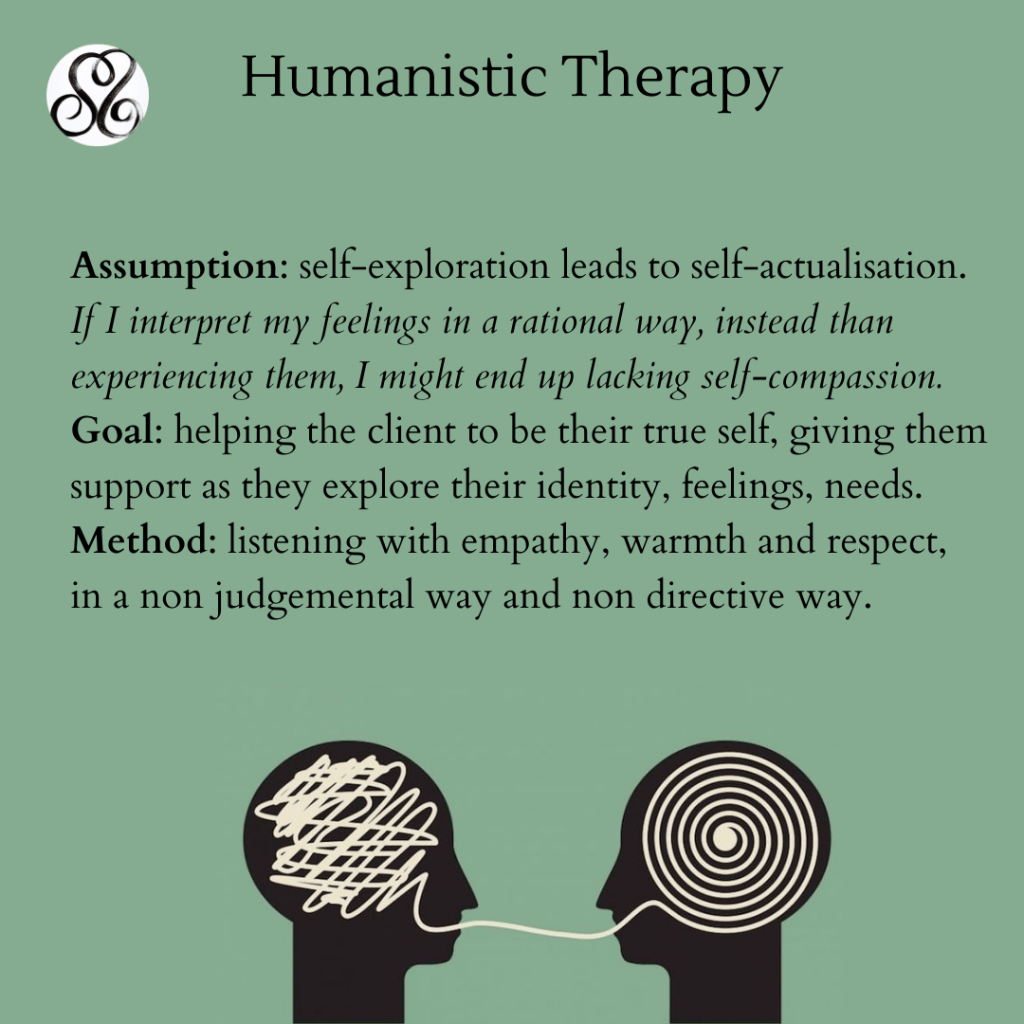
Humanistic Therapy

Assumption: self-exploration leads to self-actualisation.
If I interpret my feelings in a rational way, instead than experiencing them, I might end up lacking self-compassion.
Goal: helping the client to be their true self, giving them support as they explore their identity, feelings, needs.
Method: listening with empathy, warmth and respect, in a non judgemental way and non directive way.

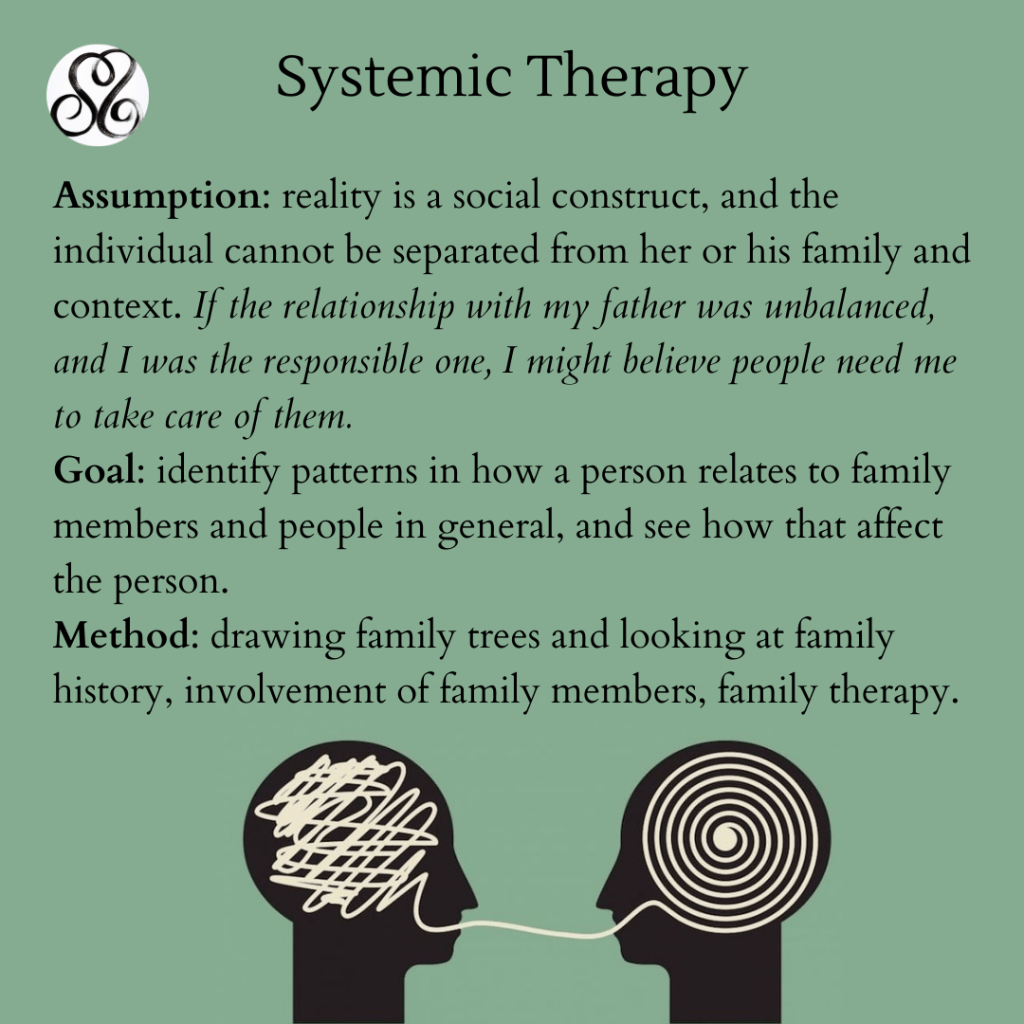
Systemic Therapy

Assumption: reality is a social construct, and the individual cannot be separated from her or his family and context.
If the relationship with my father was unbalanced, and I was the responsible one, I might believe people need me to take care of them.
Goal: identify patterns in how a person relates to family members and people in general, and see how that affect the person.
Method: drawing family trees and looking at family history, involvement of family members, family therapy.

As said before, these are just guidelines and you will rarely find a therapist that rigidly follows only one approach. Nonetheless, psychologists specialise in a certain approach, so they are guided by certain beliefs. Luckily these are not dogmas, but fluid interpretations of the world.

—Italiano—

Premesse, obiettivi e metodi di diversi approcci terapeutici

Terapia cognitivo-comportamentale

Premessa: le emozioni derivano da pensieri automatici (cognizioni).
Se credo che le persone siano generalmente cattive, mi sentirò spaventat* e sulla difensiva.
Obiettivi: contestare i pensieri automatici confrontandoli con la razionalità (le persone non sono tutte meschine) e questo cambierà le emozioni.
Metodo: definizione degli obiettivi, pratica delle tecniche, identificazione delle distorsioni, definizione dei problemi e creazione di piani per risolverli.

Psicoterapia psicodinamica

Premessa: abbiamo sentimenti inconsci che agiscono sotto la nostra coscienza e creano tensione.
Se ho paura dell’età adulta e delle sue implicazioni, ma non riesco a sopportare questa sensazione, reprimerò questa realizzazione, ma ciò influenzerà comunque il mio stato mentale.
Obiettivi: indagare desideri e paure inconsce.
Metodo: svelare i principali meccanismi di difesa, lavorare con i sogni, transfert (ciò che il paziente proietta sul terapeuta, ma che viene da altrove) e indagare non solo il presente, ma anche il passato.

Schema Therapy

Premessa: le persone ripetono determinati schemi che iniziano principalmente durante l’infanzia.
Se ho lo schema “Sono un fallimento” dettato dal fatto che i miei bisogni di riconoscimento e di valore non sono stati ascoltati, potrei interpretare la realtà attraverso quelle lenti.
Obiettivi: aiutare il paziente ad affrontare queste esigenze, accoglierle e soddisfarle.
Metodo: individuazione degli schemi e delle modalità principali. Le modalità sono mentalità temporanee che definiscono come ti senti e come reagisci in un determinato momento: potresti essere in “modalità bambino” quando ti senti vulnerabile, o in “modalità genitore” quando ti critichi.

Terapia basata sull’accettazione e sull’impegno

Premessa: accettare emozioni dolorose migliora la qualità della vita.
Se la pandemia mi sta mettendo a dura prova, rifiutarmi di accettare la verità su come mi sta colpendo, perché ho bisogno di controllo, potrebbe aumentare la mia tristezza.
Obiettivi: favorire l’accettazione, aiutare a scegliere una direzione che vogliamo nella vita e quindi agire di conseguenza.
Metodo: mindfulness, focus sui valori, impegno, stare nel momento presente.

Terapia umanistica

Premessa: l’auto-esplorazione porta all’auto-realizzazione.
Se interpreto i miei sentimenti in modo razionale, invece di sentirli, potrei finire per mancare di compassione verso me stess*.
Obiettivi: aiutare il paziente ad essere il suo vero sé, supportandol* mentre esplora la propria identità, i propri sentimenti, i propri bisogni.
Metodo: ascoltare con empatia, vicinanza e rispetto, in modo non giudicante e non direttivo.

Terapia sistemico-relazionale

Premessa: la realtà è un costrutto sociale e l’individuo non può essere separato dalla sua famiglia e dal contesto.
Se il rapporto con mio padre era sbilanciato e io ero il responsabile, potrei credere che le persone abbiano bisogno che io mi prenda cura di loro.
Obiettivi: identificare i modelli con cui una persona si relaziona ai membri della famiglia e alle persone in generale e vedere come ciò influisce su di lei/lui.
Metodo: disegnare alberi genealogici, guardare alla storia familiare, coinvolgimento dei membri della famiglia, terapia familiare.

What brings you here?

The therapeutic process starts with a question, “What brings you here?“, and an answer that is the real question, the complaint. A question that the psychologist can help interpret in a goal-oriented way, or simply deconstruct together to find what implications it holds.

In some cases this process happens before therapy, if the client’s awareness has reached a good enough level and she/he’s able to bring a more ‘raw’ version of their discomfort (“I am suffering because I keep behaving a certain way, or feeling down” rather than “I keep fighting with my partner, I want to understand who is right and who is wrong”).

Symptoms are frequently brought to therapy, and what is usually asked is “I want to get rid of them”, a reasonable goal for people who are suffering. If there is discomfort, I might want to see a professional who helps me solve that discomfort.

At this point the psychologist can answer in many different ways, based on her/his approach. 

Some might work on that symptom or complaint more directly. One example is to determine what kind of symptom it is (Is it anxiety? Is it insomnia? Is it somatic?) and draw on the psychologist’s knowledge to find which techniques are the most effective in these cases and guide the client in practicing them.

The psychologist might help the client see how some of her/his thoughts are irrational, by providing facts, and helping the client to consciously back up those thoughts and emotions with a rational response that reduces the discomfort they bring.

Another psychologist might foster the client’s acceptance towards her/his humanity and feelings, while helping them to focus on the present moment and recognise their emotional and physical states.

We could be invited to see ourselves as many different ‘selfs‘ and treat each part, especially the most vulnerable, with kindness, knowing why they are there in the first place.

Some other psychologist might work more in the long term, inviting the client to go back a little and contextualise the here-and-now with a broader image of her/his life and patterns. This can involve the client’s fantasies and desires, which lead to needs and often judgements, and these are all explored better to see where deeper issues lie (note: it’a often how we judge our feeling that creates discomfort, rather than the feeling itself).

It can also involve an exploration that is more based on family and relational dynamics in general, because any individual is placed in a social context and cannot be separated from it.

Other methods would use the therapeutic relationship itself to understand the client’s models of interaction in life, since another assumption is that we will tend to repeat our usual dynamics with our psychologist.

Mentioning all possible approaches would take a lot more than a month, but the take-home message here is that we don’t have to go blindly into therapy. Therapy is not something we treat like a black box, that we’ll only see the content once we open it. We can ask professionals how they work, which methods they use, what they believe when it comes to mental health.

This won’t grant us that we will immediately find the perfect match, but can help us make a more mindful choice based on our needs and goals.

Type of requests to a psychologist

What happens when a person seeks psychological support?

In some cases, it happens that we see a psychologist for an issue the psychologist cannot solve. For example, it’s not that uncommon that people go to ‘take someone else’, figuratively. They report their issues with this person and ask how they can make this person realise their wrongs, or even if they can take that person with them so the psychologist can directly explain what is wrong with them.

In this case the psychologist is assumed to have a magical role, one that allows her or him to fix the events around the client’s life, to change the people around them, and allow a fulfilment that does not rely on the client but on the fact that their environment has changed for the best.

At a higher level of awareness, there is the client who comes with ‘the issue’. It’s something perceived as broken or disruptive, but still external to the person in some way.

“I have insomnia, I want to be able to sleep again. Please help me with this”. Any process of broadening or connection to other issues is avoided, considered useless because the problem has already been identified and the psychologist’s task is to repair or remove it.

At the highest level of awareness, there is a question where the experience is recognised by the client as connected to them, the dissatisfaction is present and is not located elsewhere, but owned by the client who is motivated to change, and wants to find out the deeper reasons of their behaviour.

Any request can reach, with the right help, a higher level of awareness, which means better elaboration and chances for a more profound change.

A life lived more fully, where the person sees themselves clearly, honestly, and with kindness.

Before therapy

Before therapy: what happens when there is an issue, but its psychological root is not recognised?

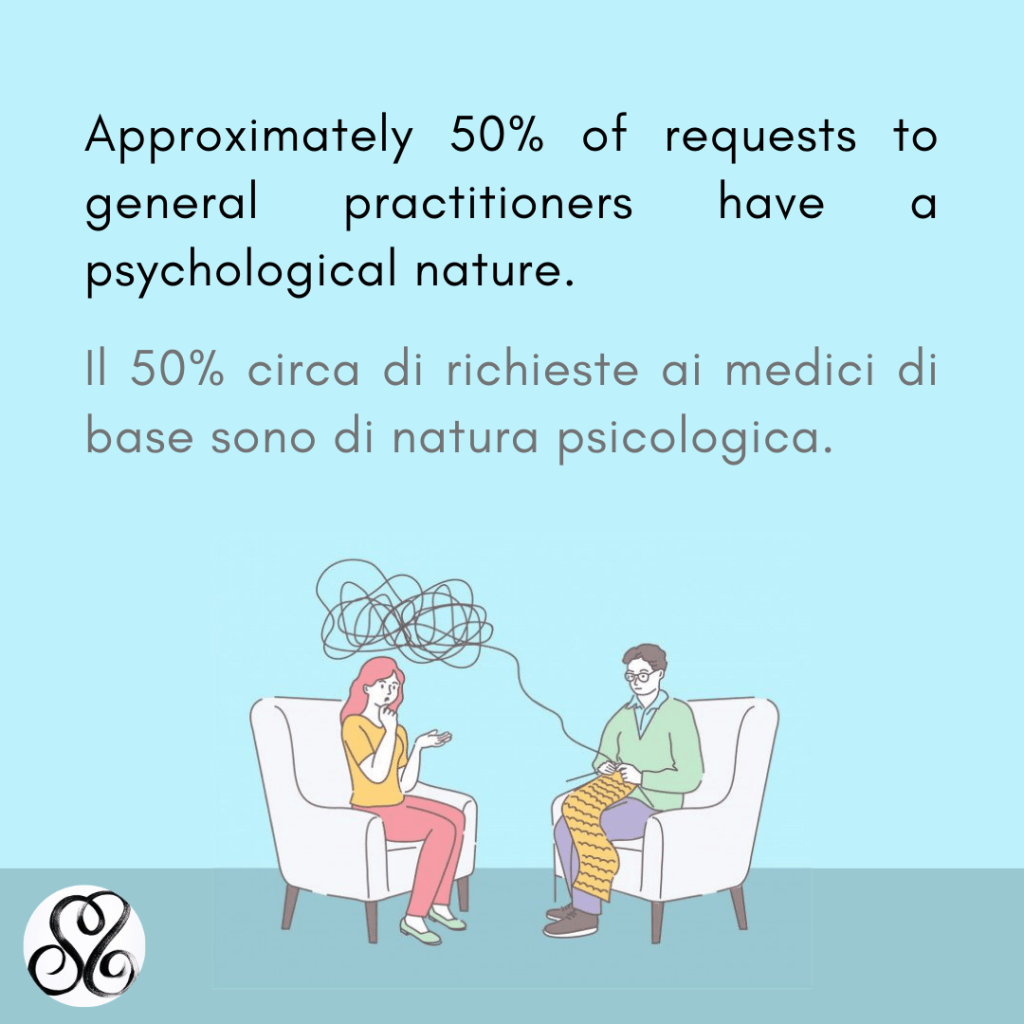
Approximately 50% of requests to general practitioners have a psychological nature, that is not necessarily recognised by the patient who asks for help.

The issues are often relational, somatic, existential, and the GP resorts to medications, instead than referring to a psychologist. This happens because it is often problematic for the doctor to identify the problem – therefore the necessity for a referral – and who to refer eventually. Even in the case of a consultation with a psychologist, it’s often unlikely for the patient to accept this referral, due to the existing stigma that although reduced still exists.

The implication of this is that many people experiencing mental discomfort, never reach out for psychological help, nor they understand the psychological nature of their problem.

The issues are temporarily and superficially solved with medications, and the problem at the core of them is not dealt with.

This system promotes a displacement of emotional distress onto a physical, external cause, and defers its resolution to some pill one can take rather than a path to walk on.

It also reflects an existing tendency of delegating the problem to more immediate solutions (medications, distraction, avoidance, repression, belittlement, sublimation) until it becomes unmanageable.

This way, people whose somatic symptoms are arising, get a prescription and keep avoiding, willingly or not, the problem at the core.

Reflection: what needs to happen for a person to realise they need the help of a psychologist?

May theme

Therapy

What is it?

When is a good time to start?

Which approaches are there?

Which approach works best for you?

What prevents beginning therapy?

What happens during therapy?

Therapy really is the best gift you can give to yourself.

Not only to heal your suffering, and learn new coping skills, but to get to know yourself better, to befriend all the parts that make you who you are, to embrace yourself with more compassion, to take up the space: the space you might feel bad in occupying elsewhere but it’s fully yours there. 

This month will bring awareness to the process, show some alternatives and answer to your questions about therapy.