What’s behind the candles

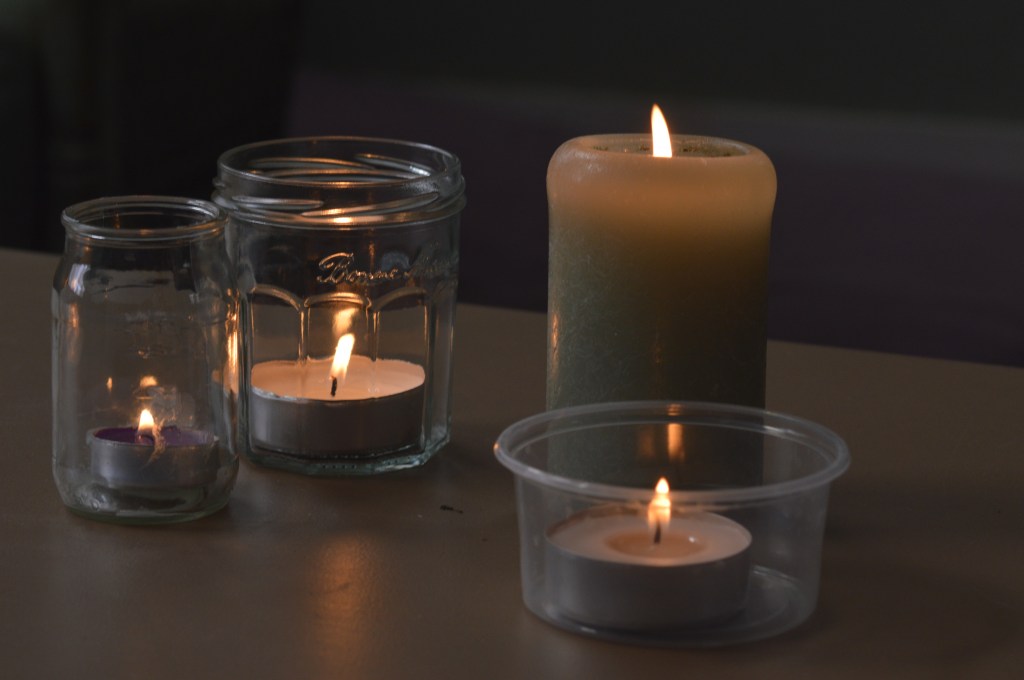
On December 30th, 2020, exactly five years ago, inspired by an interview between Tlon and Paola Maugeri, I posted a candle, with this caption:

“Lighting up torches to avoid waiting for sunrise”⁣
[…]
⁣As nature withdraws, our December becomes filled with lights, decorations, sweets, festivities, music and celebrations. ⁣
⁣While on the one hand it’s important to foster a sense of community in dark times, on the other it feeds us with easy, ready-to-consume, sugary satisfactions that satiate us but don’t do a thing for our real joy.⁣
⁣The distinction between contentment and happiness lies here: one is the placation of our immediate needs, the other is the acceptance of emptiness necessary to plant seeds for later blossoming. 🌼⁣
⁣🌚 Joy can lie in the quiet exploration of the darkness, the acceptance of life’s cycles and the observation of a profound, natural sadness of a world that dies, or subsides, to bloom again later.⁣
⁣I wish all of you a great new year’s eve, an even greater beginning of the next one, and a moment to sit where you are and ponder how beautiful a night can be, when all the lights are turned off. 🕯⁣
[…]

(Inspired by a beautiful conversation by @tlon.it and @paolamaugeri which is only available in Italian.)”

I remember clearly what happened after it. Darkness took over my mind and my life, for the following months. The descent had started around a month before this post, and continued, until I reached a very painful pit of despair, panic and loneliness. November-December-January often comes up as a package since then, as one word made of three months: first anxiety appears in my dreams, then it takes over my waking hours, lastly it freezes me.

Being alone in the world, in an utterly unspecial way, surrounded by fog. Quite literally, it was at the time of curfews, it was dark, cold, grey, and I lived high enough that I only saw the sky (or lack thereof). A world populated by ghosts, where nothing is recognizable. The walls haven’t changed, you know it, yet they look alien. Derealization they call it. You think it’s psychosis, they reassure you it isn’t. Surely it feels like existence has changed taste. Identity is a matter you can’t grasp anymore. You’re not even sure you ever did.

I am not going into the details of my own personal struggles. That fallout was the best thing that happened to me, while at the time I thought it was the worst. I desperately looked for ways to go back, shocked at the betrayal of my mind, while at the same time I couldn’t remember anything that had a taste of normal. I was not even sure anything before that existed, and I was terrified nothing after it would.

The future, however, existed. It started as I gave up trying to artificially reinstate the past. I dropped my weapons and surrendered. And slowly, with a lot of effort, and a lot of help, I decorated my abyss. When I became ready, I climbed out of it, and built a house right next to it. What humility it teaches you to know there are no clear lines between crazy and not crazy. What respect it gives you to know you’re not inherently immune to anything.

Don’t get me wrong: things don’t happen in a vacuum. Nothing that year was born that year, and no crisis is an out-of-the-blue event. My whole life anticipated this and built up to it. Nonetheless, it didn’t predict what would have happened. We can react in a multitude of ways. I had the luck of supportive systems around me, being in therapy already, being a psychologist with a deep belief in the necessity of confronting our monsters if we want to help others — and live as ourselves. This, and a lot more, made me trust there was something beyond that despair.

And there was. There was life. Life not as an actor interpreting myself. Life as a fragile, precious, cruel thing. Life as someone who can look where they’re walking.

Five years have passed and a lot has changed, while also having always been like this. All of this, all of the stuff that I found inside my hands once I opened my fists, was already here. It was already my life, I was already myself.

“The acceptance of emptiness”, not just for later blossoming, but for emptiness itself. For the revelation that nothing is empty, it’s just pregnant with space that refuses to bend to our forceful acts of prediction and filling. Emptiness, darkness, loneliness, they are not absences of their counterpart. They are bricks of meaning. To observe, to respect, to welcome.

I am finally looking at the night as something that stands on its own, not the before nor the after (or the lack) of the day.

A room full of mirrors

It’s hard to meet someone more selfish than a person who suffers. Pain — a certain kind of pain — can transform us in the blindest to others, dressing every event around us as a personal attack, and everyone else as an enemy who’s there to hurt us. This explains (without excusing) the worst things we end up saying or doing when we suffer: they are necessary to protect us.
Our mind decides rights and wrongs based on feelings, especially if it hasn’t learned clarity about those same feelings.

So in this emotional chaos where distinctions are hard so walls are arbitrarily built as a defense, and constantly moved around, the strangest paradoxes take shape. I can feel like everyone knows best, while also feeling I’m the only one who knows best. I can feel like no one understands what a good heart I have, while also thinking I’m the worst person in the world. It’s hard to make sense of these paradoxes if we don’t understand something crucial. What is called narcissism in psychodynamic terms (so not what qualifies as a narcissistic disorder) is at the core a sense of uniqueness.

It’s only me in the world. I am special.

This brings along a series of oxymorons. I’ll die tomorrow but also I’ll never die. People are better than me but also so much worse (because ultimately I even doubt they really exist). I despise and adore the same object and how much I need it. I am awesome and I am disgusting. It doesn’t really matter whether that difference has a positive or negative sign, that’s purely based on mood oscillations. What’s constant, what’s sure is that nobody suffers like me.

Nobody is like me.

This uniqueness has nothing sweet about it, it has nothing to do with recognizing ourselves as never identical to someone else. It’s like talking in a room where the only answer we receive is our echo. It’s a deep rooted loneliness, a sense of pure existential isolation.

Let’s get back to narcissism for a second, not the one that we find in the diagnostic manual, but a psychic structure shared by every human toddler. When we are born, we exist in a world of Me-ness. We don’t see any needs other than our own, not for selfish reasons, but for mere survival ones. This developmental narcissism can protract its life into adulthood if that request for help and nourishment was frustrated and caused a so called narcissistic injury. That injury causes people to remain attached to their own needs and perception in the absolute way newborns are, without an ability to feel safe when others show they also exist and have needs. That’s something our mind does often: it makes us fixed at stages that we haven’t fully lived and elaborated. In trauma, that’s also true.

Being the only one in the world is something that from functional becomes alienating when prolonged after its natural lifetime. So an adult incapable of a compassionate and empathetic gaze toward another human will live an amputated life, devoid of its lymph.

In this big room with no end, where every noise, even the subtle ones of digestion and heartbeat, are monstrously amplified, the self is surrounded by mirrors, in the hope they’ll serve as company, but with the grim result of simply showing how alone it is.

The room has a door and the door has a knob. But the point today is not to find a hopeful note. Suffice to say there are ways out of this loneliness.

I am more interested, today, in the mechanisms behind not leaving this room and not finding a door. In what makes us linger in childhood, avoidant of the world of adults. What’s outside that door?

Mostly, a complex world, with others suffering.

A complete chaos with copious amounts of beauty that have to be searched and worked for.

An intersection of needs where shortcuts don’t work.

Being the only ones in the world tells that part of us that weights 3 kilos and has no clothes, that outside of this room, if anything exists, there’s a painless world, there’s salvation, there’s warmth and embrace, there’s finally peace. Once for all. Nothing to fight for anymore, no needs, no frustration, no embarrassment, no humiliation. We’ll sit on a cozy chair, and look at things unravel beautifully in front of our eyes.

I am not here for hope today, because sometimes it’s vital to be grounded and honest before being hopeful.

Outside of here, it’s still a mess. Even messier than a room with mirrors. Me-ness saves us from the hard truth of life being ruthless, hard, layered, contradictory, unexpected, sharp.

And it works in saving us from that.

Anxiety invents a scenario, invents a room of possibilities, to avoid confronting the endless other things that can go wrong.

Paranoia invents thoughts that puts in other minds, to pretend it can know what’s there, because even the worst thought I can imagine is better than the one I can’t.

I am not here to argue that these unknowns are not scary. I am not here to open the door for you. I am not here to get you out of that room by lying about how sunny it is outside. I know it’s scary, and I know how lonely it is in there. I have my own room some days it’s harder to find a way out of, or nice furniture to put in.

Yet, I haven’t met a single person who’d like to go back to that room once they have found a knob.

Dot dot dot

December asks few words and gives even less. It’s cheap with images, thrifty with sounds, neutral in smells.

I’m inhabited by a sense of quiet wait, patient suspension. Things will have time to happen, and underneath everything there’s an invisible fertility that has just slowed down but never stopped. If you pay close attention, you can hear smaller noises. If you look attentively, you can zoom in and see the yellows inside the grey.

Don’t let December fool you, let it convince you. Be there fully with body and mind, where death and decadence can sit next to you without pretending to be opposed to life and fullness, but hand in hand with all that’s moving.

Don’t let December confuse you, let it shock you to your core and then hug you back to sleep.

Don’t do it, or you, the disservice of comparing. December stands on its own.

Don’t utter anything other than words that will fade into oblivion.

I become the size of nothingness

I walk on the verge of aliveness

I find relief in shapelessness

I surrender to the abundance of emptiness

It can help sometimes to take existence a bit less seriously, with the utmost respect.

Hello darkness, my estranged friend

There’s a reason why it’s so hard for a politician to tell their potential electors they will tax people more. Those people will probably not vote for them.
Similarly, it’s hard for a psychologist to say that therapy doesn’t always make you feel better immediately and that it takes long to get deep inside yourself and heal. Hell, some of them (me included) might even say that healing is hard to define and even harder to accomplish. People often gravitate towards someone (friend, therapist, confidant) that promises to have “evidence“ on their side and know an always effective method to treat them with or advice to give them. Quick, straightforward, practical.
It doesn’t take a genius to understand why we do this. We want things to improve but rarely are willing to do it at our own expense. In other words, we often choose to believe in easy fixes, often at the hands of others, because they provide a reassuring image of the world and save us the hassle of contributing (which removes things from the divine hands we consider so comforting).

As an Italian living in the Netherlands, I have been (and will always be) in the middle of both cultures, closer to one or to the other depending on the situation, or on how much pasta surrounds me (that’s how the unconscious works, trust me). A “nation orphan” I call it, someone who has lost something to call motherland, and hasn’t necessarily gained another, while it’s also true this person is one with an extended family. Both things are true. This has put me, like many others, in a stroopwafel limbo, where Italy looks far, and the Netherlands isn’t close either. In other words, I have a distance from both (while also calling both ‘home’ and loving them deeply) that has always helped me analyze them.

A striking difference in the university system: in Italy we created a grade higher than the highest (30 e lode) to reward students who have gone beyond knowledge and added true mastery, a committed participation in the discipline. In the Dutch university system, 10 is never to be seen, and even 9 is a mirage. 8, objectively one fifth below the maximum grade, is what greatness deserves. Doe normaal. This is fascinating not as a dry fact, but as an ulterior confirmation of some aspects of both cultures. One of them cuddles the ego of its youth, while also amputating every possibility of it turning into adults; the other invites everyone to aim at average, because extravagance is not rewarded, and ultimately not needed. You’ll get a job, chill.

In the health system there’s another big difference. Italy has had a very lenient and spoiling medical staff. Antibiotics given out like candies, medical exams allowed for the slightest suspicion, and a consequent collapse of a public system because of no more money. The Netherlands has a policy of “You’ll come back if it’s really bad, and then we’ll do something. Meanwhile, paracetamoltje?”. Allow me to be critical of both, while also seeing their motivations and understanding their good faith. And I’ll be critical not because they are bad (they might be, I’m not the one to decide) but because anything in the world loses some while gaining something else. So no perfect option exists, but just partial alternatives.

This said, we have preferences. And I always preferred The Netherlands for most part. Italy has the tremendous power of frustrating your patience over and over — which for some is an aphrodisiac or a driver, but for me was just exhausting. Here in the flat land up north I found civility, the victory of reason over the belly. How beautiful to see rules being robotically followed. No questions asked. To me this was like wearing glasses that showed you the future. Italy will also get there in ___ amount of years. Unfortunately, it seems to me this didn’t turn out to be exactly the trend.

I saw this modern and efficient country as being so many more steps into the future than my home country. For quite some time, I found this practical approach very solid. Did you know that anger and other strong emotions arise more easily where it’s hot? I was not surprised when I found out. It only confirmed what I found so incredible here: rational people moved by well-described and clear intentions. Wow.

However, with time I saw the side effect of this — and a confirmation that, as I said earlier, there really isn’t better or worse, but just partial alternatives with different pro’s and con’s — and this showed me how much belly can be contained in the brain. All this rationality, at the cost of such effort to avoid the darkness. All these solution, all this efficiency, at the cost of some good old basking in torment and destruction.

Do I sound ironic to you? I swear I’m not. I am convinced torment shouldn’t always be escaped. I am convinced a system that rushes people out of short therapy plans is not just motivated by money and lack of resources, but also by a desperate and pointless attempt to deny the world is made of worms, and not just birds, our minds flirt with madness, not just with highness.

Too fast to go anywhere

I always enjoyed trains. What seems now to be treated as a meme of neurodivergence is actually not an uncommon trait.
Ask around, and many people will tell you they find trains relaxing or soothing in some intangible way. With due exceptions, like crowdedness or Italian delays, there is some comfort in moving while being still.
There is something pleasing for our sense of cohesion when we sit in a train and look outside: it merges our need to move and our need to stay. With the satisfaction of being headed somewhere without having to do much about it, we can find a different form of stillness.

Restlessness is a stuck movement or fidgety stillness. Something that went wrong in the process of integration of the two. Gabor Mate in his book Scattered Minds uses an example that explains this elegantly. If there’s a lot of traffic and the traffic light doesn’t work, that mess turns into an activated, frustrating and purposeless stillness. Stuff keeps coming in, and the lack of resources to handle it turns everything into restlessness. Potential movement never satisfied.

If intention is not directed and channeled, no movement nor stillness exist. A frozen state doesn’t allow staying nor leaving, comfort nor exploration. So the body loses its potential, the mind loses focus and drive, the person loses herself.

It’s often counterintuitive how something like amphetamines could calm restlessness or aimlessness in ADHD patients. Something activating by definition relieves the symptoms of hyperactivity or distraction. How? By channeling energies that get wasted instead. Let’s not fall into the trap of calling things a “waste” or “lazy” in the traditional sense. Waste is not about failing in our goals of productivity. Waste is not about misusing or not using our skills. Waste is not in relation to producing or consuming according to the not so veiled requirements of our culture. Waste means: so much is invested into a goal or a purpose, whether mentally (with draining rumination and guilt) or practically (with planning, postponing, canceling) and nothing is accomplished in that direction, nor it’s accepted to just quit and invest energies elsewhere. A frozen state of maybes where peace is never found, and resolution isn’t either.

Too much movement, like in a hamster wheel, that becomes a delusional and never ending still here. Over and over and over.

In many psychological disorders we can find some form of derailed going or derailed staying.

Anxiety: I can’t stop predicting, I’m always in the future.
Depression: I can’t move. Today, tomorrow and 10 years from now all look the same.
Post-traumatic disorders: I can’t leave from that place where I was hurt. By never leaving, I never move on.
Dependent disorders: The value of our bond depends on its ability to last forever, unchanged.

If I can’t move, I can’t stay. If I can’t stay, I can’t move. And in fact, whether they look similar or not, all these forms of suffering have that same fixation, that same purposelessness, that same overandoverness.

Back to our train, the perfect metaphor for integration: as something moves me, reliable and smooth, I can appreciate the folded and airy nature of presence. Here, while some of me knows and contemplates there. So we can free up space, and over and over becomes a flow. Movement that grounds. Presence that liberates.

Eyes on the goal and away from you

The person who really knows what they want has a good reputation in our society. Assertive, voracious, desiring and desirable. “She really knows what she wants”, similar to “he’s a self made man”. Almost a mythological creature.
Raised by wolves or aliens, the person who knows what she wants is usually a doer. She sees, she aims, she hits, she puts in her pocket. With a proud smirk she walks away, onto the next target. Focused on the goal at all times.

Are doers wanters though?

The question of “What do I want?” or “Why don’t I know what I want?” comes up often in sessions. Secondary only to “Who am I?”, when it’s in fact the same question, but easier to ask, and less painful not to know the answer to. After all, don’t we want others to be happy? And don’t we want to do a good job? Don’t we also want to stay together? It’d be hard to argue otherwise. I, for one, couldn’t tell my clients if their wants are genuine or not, only based on the content.

It’s very hard to draw a line between societally imposed wants and internally originated ones, especially if we agree there is no such thing as purely societal or purely internal, and none of the two would exist without the other.
Yet, how is it so easy to spot someone who knows where to locate themselves and their desires? Someone who’s not unaware or careless about others and society at large, but that knows where his belly is. Even without the ability to describe it in words, my visceral intuition can sense it quite accurately. And it’s almost never the doer.

The one who seems to be always ready with his hand to catch a fish in the water, to the point that he has forgotten to check whether he’s hungry or he even likes fish in the first place, is a perfect product of the historical moment we live in. I was recently listening to an interesting podcast on sex (Come as you are), and the theme of intercourse frequency led to Nagoski’s reflection: “Capitalism profits on us wanting things, not on cherishing having them”. It’s, like every beautiful insight, one that transcends disciplines and discourses. It can be applied to so much more than what it was meant to.

We are programmed by our system to always want. Next task, next project, next pair of shoes, next holiday, next challenge, next difficult yoga pose. But is this wanting? Or is it a perverse distortion of a desperate craving that can never be satiated?

If I can’t sit on the hill I climbed for longer than taking a picture, I was addicted to the climb, but I didn’t want the hill. If I have to force myself to be proud and happy for an accomplishment, just for the time of a celebration, then that accomplishment added nothing to my life.

Let’s be clear: moving from old to new is not something to demonize. Change is a necessity of our body, mind and our entire cultures need to burn some ground to fertilize the land.

Wanting in the sense of being oneself has little to do with seeing, spotting and grabbing. More with opening ourselves in the right places so the thing, the object of our blind desire, can see, spot and grab us. There’s a lot of receiving in wanting. A lot of happening.

The search for who we are exactly, and what our house should definitely look like, and what we can’t absolutely stand in a relationship, our hard lines and our rigid boundaries show more often than not how little we know about who we are and what we want, and how adamantly we are trying to trace that picture as neatly as possible to avoid the blur we host inside.

So how do we find out what we want? How do we learn the language of our desire?

If I had the answer I’d tell you, I swear. If anything because I believe a world made of people who harbor desires is a happier, healthier world. But there’s no manual, and beware of the ones who try to sell you one.

What I know is this: we are submerged by things. Not just objects, but thoughts, ideas, opinions. We often hold on to something because we’d like to be the ones who want that. All that space could be used for things we want a bit more truly, but we don’t get there because the idea of wanting certain things terrifies us. We are not guaranteed we’ll find passions that would make our parents proud, or tendencies that others will admire. So we stick to the usual, and see our motivation fade, our light dim. We become very good at doing things we’re instructed to do, and that becomes our real calling. Then we feel time is slipping away, but if we had more, we wouldn’t know what to do with it other than shoving things in it, and then feeling once more it was not enough.

Let’s be respectful towards our desires. They are not monstrous creatures, but also not the patinated, branded and profitable thing capitalism has told us it is. They have to be approached patiently, curiously and often carefully. We’ll find darkness too, and it’s exactly that fear that our false self feeds on. Being ready for the darkness that we are, being ready to never fully grasp it, to never fully own it, and to end up ultimately losing against it, but being reignited in our need to be alive by exactly that: having this companion beside us at all times, knowing that it has no intention to bring us down, but wants to show us who we are when no one’s looking.

Not so easy, is it? That’s why so many of us end up being doers.

Unclear messages

My skin talks a lot. It goes on and on and on about everything and nothing and most of the time I can’t even grasp what it’s telling me.

– You don’t know what happened to me the other day. Unbelievable!
– What?
– This crazy thing! Crazy things always happen to me. Like have I ever told you about that time…
– Wait. What happened this time?
– Crap, I totally forgot.
– Which one?
– Both. Actually, what were we talking about?

My skin dries, acts out, reddens, swells. It says it needs something, it shouts something is wrong, but when I ask what that is, it refuses to answer.
With time, I finally started to learn its language. And at first I found it manipulative. It’d often become greasy when it needed fat. It dried out when I moisturized it too much. It reacts with an excess of what it’s lacking. If not manipulative, it’s at least contorted.

Then I started to see this paradoxical reaction in other things as well.

My neck has a history of being stiff, tense, and, as a consequence, sore. In my head, this rigidity translated into “too much strength and little mobility” — like those people who lift a lot of heavy weights and the strength in their muscles makes it hard to bend and fold naturally. As a response, I’d move it around its axis over and over, in the hope to “loosen it up”. However, the more I learn about the body through yoga, the more I understand that my stiffness was asking for strength and support (sthira) and not for ease and openness (sukha). My neck was asking me to heal compression with compression.

Before I continue let me add a halfway disclaimer: body and mind don’t communicate in just one way. We can’t apply what we learn to all instances in which something is off. This is a common tendency: finding something that works or gives pleasure and doing it to solve any issue we encounter. It saves us the time to think but it rarely leads to anything good. So if your neck is stiff, consult a professional.

When in table top I often felt wrists and hands burdened by too much weight. Yet, I’m not overweight and I didn’t think I had weak arms. It was (not so) surprising to find out that what was actually weak was… my legs. My arms had to compensate to support me, but they were never the issue in the first place. This example is slightly different but it’s saying the same thing: “It might seem like here is the problem, but you have to look there”.

The body, just like the mind, is often not literal. It speaks with metaphors and hyperboles. It’s full of paradoxes and has no clear lines and distinctions.

In moments where I felt I should have had more, periods in which I harbored fantasies of ownership and possession, in which I needed reassurance of what was mine, it turned out what I needed was to give. Not to wait for better moments so I could be generous but be generous while having nothing — or what seemed like nothing.

I could:

  • Recognize and accept what was foreign, when I knew I had some immunity against invasion
  • Be intentional, when I learned how to let things happen
  • Believe my identity is clear, once I understood it exists within social dynamics
  • Travel, once I felt at home

This in itself teaches us nothing more than another way to interpret the signals and symptoms of our organism — which is already a lot —, a more “yes this but also this” kind of approach. But if we zoom out just enough to see the bigger picture, it tells us that rushed, forceful and automatic responses do little for the issue and little also for our sense of control, while promising to do a lot for both.

I’d have missed my opportunity to communicate well if you finish this post thinking “Ah, let me add this to the list of methods to try when I want to fix things.”

Let the take home message be: answers are not always so obvious, solutions can’t be sought through repetitive and literal strategies. A curious observation is needed to find the unusual and uncommon, which are, it turns out, quite usual and common when it comes to humans.

Shuffled observation

Let’s say you’re in front of the mirror, and by lifting up your right arm you notice a small pimple on your elbow. You’d go check with your left hand to confirm its texture, expecting something quite specific. You’ll confirm it’s a pimple quickly, with a simple touch.

Similarly, you might check your hair, observe it with a critical gaze. Its softness — or lack thereof — will be easy to predict, and you’ll anticipate it way before putting your hand on it to confirm it.

Deduction is a skill. Guessing on few data, finding patters, relationships, equations to explain and connect. We’re relatively good at it. And most of it we do unconsciously. It goes without saying though, that machines are better. Machines don’t get distracted with other data or desires. The dry observation and consequent calculation is their biggest strength. Our strength is different, and it coincides also with our biggest issue.

An anthropologist named Ernest Becker wrote this about us in 1973:

As Maslow has well said, “It is precisely the godlike in ourselves that we are ambivalent about, fascinated by and fearful of, motivated to and defensive against. This is one aspect of the basic human predicament, that we are simultaneously worms and gods.” There it is again: gods with anuses.

He calls us gods with anuses. Which is not only a funny image, but also the biggest source of our conflicts. We are not the best at either, our analysis is not spotless and our instincts are not straightforward, but our potential lies in having both: the analytical, elevated mind and the primitive, visceral needs. If we only train one, we’re losing the beauty of having them mutually inform each other.

Let’s get back to observing. What would happen if we’d give up for a second the illusion of being able to make accurate assessments and predictions? If in observing all those variables we asked for the help of our belly (although Becker would say our anus)?

The “belly” has a whole other way to connect things and make predictions, functional to other forms of survival. If I look at my face and see rings under my eyes I might make a judgement on looks, fatigue, products to use, and stop there, or spice up that analysis with the matter-of-factness that my body is very good at. Things start emerging, non linear and evocative. Rings, circles, bed, October, hours, time, sorrow, hollow, full, moon, sight… It feeds itself and could go on forever. I stop and look at things that make no apparent sense. I learn to observe in another way. Observe a picture I’ve painted, an image that keeps moving but goes nowhere.

What would happen if we trained visceral analysis and elevated impulses?

In the face of data: emotions.

In the face of emotions: reflection.

Stop, observe, take the hand of the god and the hand of the worm. Ask their help in tasks that you were always taught needed hyper specialization and instead can benefit from full on chaos and shuffling.

The incel in me

It’s very hard to make distinctions of suffering. At best, it raises the question of why should we even attempt that. Which pain is worse, which pain is better, who suffers more between me and you. What a vulgar way to treat creatures.

In 1951, a German psychoanalyst called Karen Horney wrote a book with the title “Neurosis and human growth”. The word neurosis was at the peak of its use then, while it’s not as used now. Nonetheless, its meaning largely varied based on who was using it, when and where. Its definition could range from something neither healthy nor psychotic (a kind of mild state of mental illness), or, like in this book, a distance from what she calls Real Self. She says this: “And that is why I speak now and throughout this book of the real self as that central inner force, common to all human beings and yet unique in each, which is the deep source of growth.”. Those who are lucky enough in their upbringing will have few layers above that central authentic part, the others will need time and healing to reach inside for it, because their life and character is defined by shoulds that outnumber the wants. Later on, another psychoanalyst would be known as the “owner” of this concept, studying children in detail to predict what is necessary to develop a True Self. His name was Donald Winnicott.

In this book, Horney mentions anecdotes about her life, which has been at times an example of neurosis rather than authenticity. One is about a train delay that was a great source of discomfort. This discomfort was phrased by her inner voice along these lines: this unfair thing is happening to me. Looking back on this experience and the quality of her emotional reaction, she defines it neurotic pain. In hindsight, she has no trouble empathizing with her annoyance, and finds the frustrating nature of the situation undeniable. Yet, there is a difference between “how unfair, the world is out to get me” and “this sucks, I feel terrible”, and it’s not the intensity. It’s the quality.

“I am owed this” is often at the core of our suffering, although often in disguise. We would refrain from saying it out loud, and it’s rare to even be conscious of it. Nevertheless, there are accurate ways to spot this underlying thought when it lingers inside our complaining.

“I do so much and get nothing back”

”This always happens to me”

”I didn’t deserve this”

“After everything I’ve done, this is what I get”

”Other people get lucky. I never do.”

You’ve heard some version of this. You’ve said some version of this.

And don’t worry, I am not sending the police of dysfunctional your way. I have uttered similar words too.

It’s easy to slip into taking circumstances personally, and it’s equally easy to think: “Well, what happened to me was awful. Should I have not complained or suffered?”, but the point is not suffering. We are allowed to scream in pain, and we’re allowed to change opinion on life, fate, people, after things happen to us. That is a matter of emotional realism: my emotions can and will dictate my perception.

Being owed a retribution, instead, is a delusion. I do not deserve pain simply because I do not deserve anything at all. I don’t deserve good things, I don’t deserve bad things. There’s an element of chance in life that can scare us, leading us to lean on extremes: controlling everything or letting go of everything (the obsessive kind and the depressive kind respectively). In the space outside of these extremes, once again, there is a truer reality: the non-neurotic pain and non-neurotic response for Horney, which we can simply call the response of the sane person.

It goes like this: “Life is partially chaos, partially something I can influence. I recognize that chaos is scary, and I befriend it. It’ll surprise me with beauty at times, and tragedy at other times. Occasionally, it’ll give me what I worked for, and I’ll welcome that with gratitude. When it’ll give me hell, I’ll allow myself all the tears and shouts I need, harboring inside of me an ever present part that knows that’s what life is, and there’s nothing personal about it. I am simply yet another creature that lives, thrives, succumbs, tries.”

The book Rejection, by Tony Tulathimutte, collects disturbingly funny stories of people who experience both: the belief they are owed something, and the constant reminder they aren’t. Instead than updating their internal system as a consequence of reality, they remain split: the grandiose who deserves glory and the pathetic who is left to rot. Too bad they’ll never find out they’re none.

(The whole book can be found here.)

Hold that thought

I have started a training in Yin Yoga, after one in Vinyasa. If you don’t know what I’m talking about, let me give a brief and simplistic explanation that will anger the advocates of complexity (including myself): Vinyasa is centered around a “flowy”, dynamic practice, while Yin is based on holding poses for longer. Looking from the outside you’ll find people standing, balancing or moving a lot more in the former, while you’ll often see them sitting, folding or lying down in Yin classes. “Well, actually…” “Yes, I know it’s a simplification. That’s what the disclaimer was for” (me responding to me nit-picking).

There’s a very specific way in which this practice is challenging. Discipline and surrendering are so closely intertwined that it’s hard to tell whether you’re resisting or letting go. And if there’s something that Yin teaches you is exactly this: things contain their opposite and much more. There’s no Yin without Yang. Relaxing, sinking, leaning are all things we have to earn.

Letting go is actually a lot of work.

In Yin you’re not asked to “push through” like they might instruct you in a pilates class. It’s not that kind of holding. You usually hold poses that in other yoga classes constitute the much desired end of a cycle, or some momentary relief: forward folds, child’s poses, twists. This way Yin tricks your brain into thinking this will be “chill hour”, only to realize how fast your mind is going, and how hard it is to tell it to chill. You are gently invited to find space in confinement, to make stillness a resource, a window of clarity and mindful suspension.

In Yin, to hold means to stay. To tolerate. Learning to sustain a certain amount of frustration and restlessness is at the core of it, so when any of these uncomfortable feelings arise, they are not expelled with the help of energetic movements, but sustained with big breaths.

Sounds terrible, doesn’t it? It sure does to me.

If you’d ask me what resembles torture the most amongst relatively non torturing things, it would be this: to stay still and hold that stillness. Not just that, to hold that stillness without grinding your teeth or squeezing the air with your fists.

Soft discipline.

Gentle intensity.

A paradox.

Inhabiting a space where nothing happens, so everything can happen.

Impulsive people like me, when they go to therapy, learn to suspend their actions in favor of reflection. For some time, they lose spontaneity, and are confronted with a much less raw experience. Isn’t it a sign of authenticity to transform emotions and thoughts into the immediacy of visible facts? How come healing means withholding? Well, actually…

Healing means moving. From somewhere stuck and rotten, to somewhere new. We can be stuck by keeping everything in, but we can also be stuck in throwing everything out, as an uncontrolled reflex. Our safest ways are often either inside our outside of our skin. That’s why holding for a second longer can be so groundbreaking: during that automation, it stops that thought exactly where it hurts more, on our skin. On its way out or in.

Hold that thought. Before it enters, before it exits. Ask it where it comes from and where it wants to go. Stay with it one more breath. Change perspective. On your next breath, it might have changed so much that you don’t want to get rid of it anymore.

So? Healing is moving. Healing is staying.

When opposites collaborate rather than clashing, that’s healing.

On our healing paths we learn the patience to hold thoughts, positions, time.
We learn that urgency has little truth, and the only thing not worth holding is our breath.