It’s a joy to be hidden,
and a disaster not to be found.
D. W. Winnicott
What I can help you with:
- Your feelings of being a misfit
- Learn more about yourself
- Be tender with your weirdness and darker spots
- Feel at home in your body and mind
- Get to say: “I love how complex I am” (and mean it)
- Experience things without always feeling too much or nothing at all
- Emancipate yourself from the ‘good girl’, the ‘golden child’, the ‘responsible one’, as well as the ‘black sheep’, the ‘angry one’, the ‘rebel of the family’, the ‘selfish one’
What I can’t help you with:
- I can’t fix you, give you advice on what to do, who to be, what is right or wrong, skills to control or reshape parts of yourself you don’t like
I am here to witness (and facilitate) you turning into yourself.
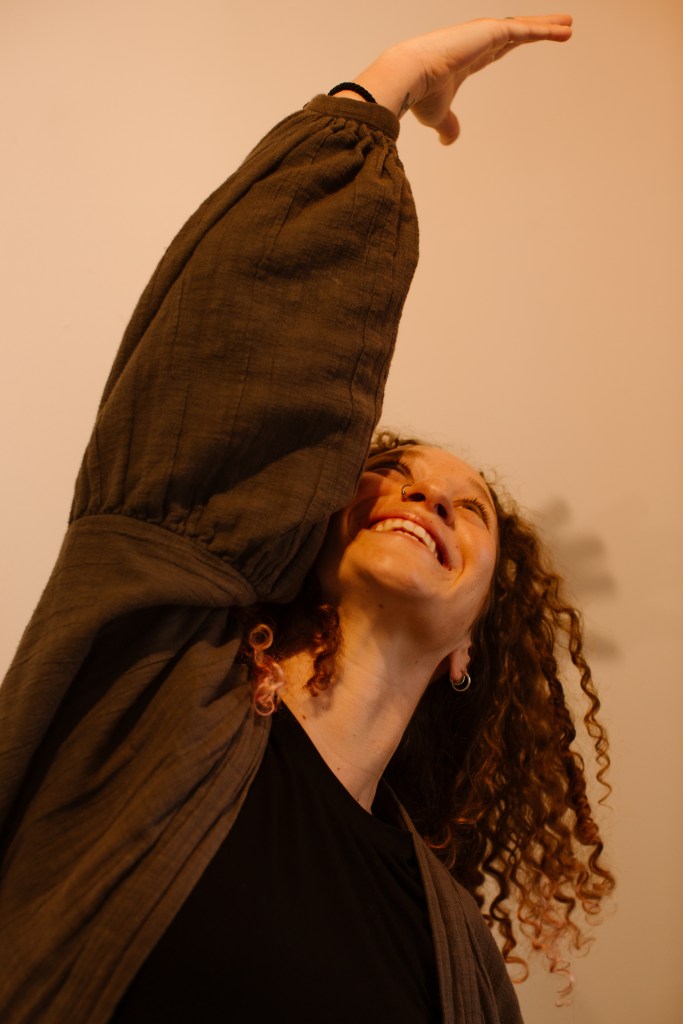
Who I am
I am a lively human and an inspired psychologist. I have felt like an outsider most of my life, until I learned what it meant to belong, through therapy and yoga — but also having the most beautiful chosen family I could hope for.
I have strong interests that have guided me since I was younger: movies, books, music, people. Many more make their appearance and leave on monthly basis.
I love to delve into many different fields and have a broad view. I approach all of the things I like very analytically and passionately.
Within psychology, I am an avid learner of many approaches, from Acceptance and Commitment Therapy to Psychoanalysis, but I also worked as a researcher, a tutor and graduated as a neuropsychologist.
When it comes to counselling, my eclecticism allows me to draw from different ‘jars of knowledge’ and adapt to the complexity of my clients.
My approach is dedicated to understanding core ambivalences and hidden defenses. Those things about ourselves that we look at with dismay, struggling to understand why we keep ending up in places that hurt, or why we repeat the same mistakes even though we are aware of the consequences; those things are often ways in which we tell ourselves that there is not just one thing we want (namely, feeling happy, satisfied, fulfilled) but perhaps a whole array of things that hide much better and that we are less proud or aware of. What our discomfort tells us is that we are a multitude of things, and that life and people cannot be reduced to simple rules, but deserve the time to be understood.
We may want to avoid forgetting our keys or missing an appointment, but we also want to avoid being constantly preoccupied.
We may desire a close and warm relationship, while also feeling the need to be independent and self-sufficient.
We may strive to keep our anger managed and functional, while on the other hand we want to be sure to speak up when we see injustice.
Ambivalence is everywhere.
And once it’s spoken of, and looked at with a curious, non-judgemental attitude, then we can discover ourselves, make mindful choices, know what we are leaving behind and what we are, instead, embracing.
And, along the process, we might be able to embrace more than we think we are capable of.
My background
My academic path started in Rome, where I’ve attended a ‘Psychology and Health’ Bachelor with a strong psychodynamic inclination. What this means is that there was a big focus on that part of the mind we don’t control (the unconscious) and all our strategies we use to attempt to do so (the defense mechanisms). This allowed me to discover early on an affinity with this approach, and I became fascinated with the unconscious. The attention to detail is a strength I learned in this context and took with me when I came to The Netherlands, where a more pragmatic and goal-oriented style helped me grow in a complete way. I followed a Master’s in Clinical Neuropsychology where I had the occasion to do research in many areas, and draw from other psychological disciplines to expand my knowledge of the subject. I kept learning through a clinical internship and a second Master’s in Florence, where I wrote a thesis on authenticity, a topic that I focus on in my practice.
In the past five years, I’ve encountered Yoga. Casually, suddenly, luckily.
The studio where I had done a trial class moved right next to my house (I mean literally next to, I never wore a coat to go to class), so I took it as a sign and got a subscription. I ended up attending classes almost every day, from Vinyasa to Pilates, then Yin, Restorative, Relax Flow. I found the right teachers and the right approach so I decided to start a training. Then two. Then three.
Now I teach yoga alongside my psychology practice, and combine it with my interest for the psyche, a potent guide of needs and resources. I can’t think of ever going back to a mind-centered approach, now that I know how much we do not HAVE a body, but we ARE one.
In the intersection of these two beautiful languages, I created my workshop Get Unstuck.
Check me out on LinkedIn.
 Empatherapy