It’s hard to meet someone more selfish than a person who suffers. Pain — a certain kind of pain — can transform us in the blindest to others, dressing every event around us as a personal attack, and everyone else as an enemy who’s there to hurt us. This explains (without excusing) the worst things we end up saying or doing when we suffer: they are necessary to protect us.
Our mind decides rights and wrongs based on feelings, especially if it hasn’t learned clarity about those same feelings.
So in this emotional chaos where distinctions are hard so walls are arbitrarily built as a defense, and constantly moved around, the strangest paradoxes take shape. I can feel like everyone knows best, while also feeling I’m the only one who knows best. I can feel like no one understands what a good heart I have, while also thinking I’m the worst person in the world. It’s hard to make sense of these paradoxes if we don’t understand something crucial. What is called narcissism in psychodynamic terms (so not what qualifies as a narcissistic disorder) is at the core a sense of uniqueness.
It’s only me in the world. I am special.
This brings along a series of oxymorons. I’ll die tomorrow but also I’ll never die. People are better than me but also so much worse (because ultimately I even doubt they really exist). I despise and adore the same object and how much I need it. I am awesome and I am disgusting. It doesn’t really matter whether that difference has a positive or negative sign, that’s purely based on mood oscillations. What’s constant, what’s sure is that nobody suffers like me.
Nobody is like me.
This uniqueness has nothing sweet about it, it has nothing to do with recognizing ourselves as never identical to someone else. It’s like talking in a room where the only answer we receive is our echo. It’s a deep rooted loneliness, a sense of pure existential isolation.
Let’s get back to narcissism for a second, not the one that we find in the diagnostic manual, but a psychic structure shared by every human toddler. When we are born, we exist in a world of Me-ness. We don’t see any needs other than our own, not for selfish reasons, but for mere survival ones. This developmental narcissism can protract its life into adulthood if that request for help and nourishment was frustrated and caused a so called narcissistic injury. That injury causes people to remain attached to their own needs and perception in the absolute way newborns are, without an ability to feel safe when others show they also exist and have needs. That’s something our mind does often: it makes us fixed at stages that we haven’t fully lived and elaborated. In trauma, that’s also true.
Being the only one in the world is something that from functional becomes alienating when prolonged after its natural lifetime. So an adult incapable of a compassionate and empathetic gaze toward another human will live an amputated life, devoid of its lymph.
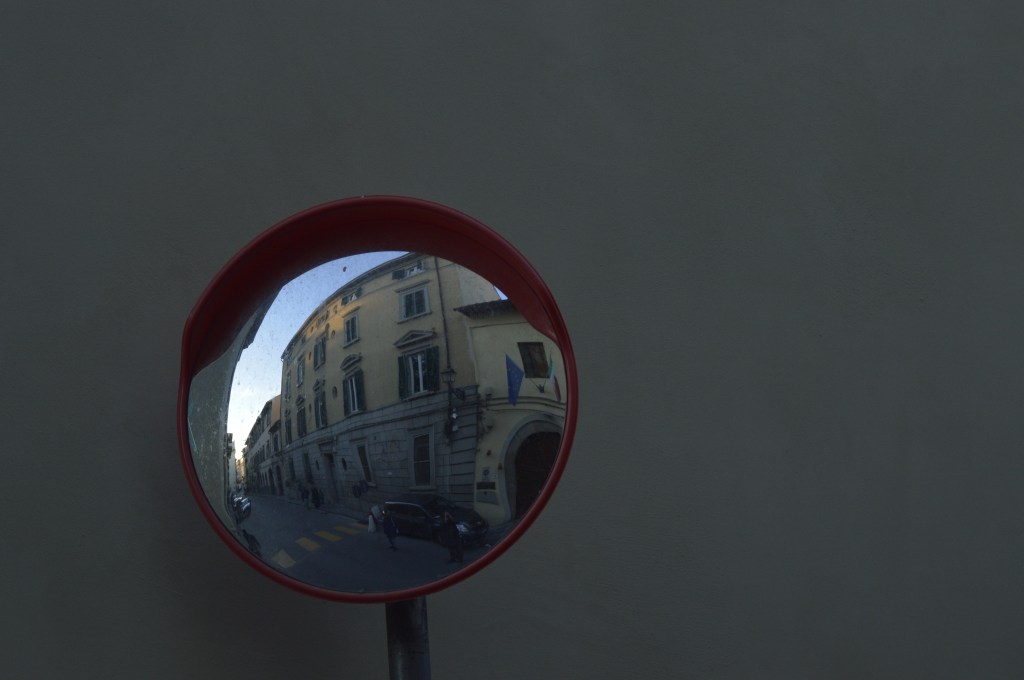
In this big room with no end, where every noise, even the subtle ones of digestion and heartbeat, are monstrously amplified, the self is surrounded by mirrors, in the hope they’ll serve as company, but with the grim result of simply showing how alone it is.
The room has a door and the door has a knob. But the point today is not to find a hopeful note. Suffice to say there are ways out of this loneliness.
I am more interested, today, in the mechanisms behind not leaving this room and not finding a door. In what makes us linger in childhood, avoidant of the world of adults. What’s outside that door?
Mostly, a complex world, with others suffering.
A complete chaos with copious amounts of beauty that have to be searched and worked for.
An intersection of needs where shortcuts don’t work.
Being the only ones in the world tells that part of us that weights 3 kilos and has no clothes, that outside of this room, if anything exists, there’s a painless world, there’s salvation, there’s warmth and embrace, there’s finally peace. Once for all. Nothing to fight for anymore, no needs, no frustration, no embarrassment, no humiliation. We’ll sit on a cozy chair, and look at things unravel beautifully in front of our eyes.
I am not here for hope today, because sometimes it’s vital to be grounded and honest before being hopeful.
Outside of here, it’s still a mess. Even messier than a room with mirrors. Me-ness saves us from the hard truth of life being ruthless, hard, layered, contradictory, unexpected, sharp.
And it works in saving us from that.
Anxiety invents a scenario, invents a room of possibilities, to avoid confronting the endless other things that can go wrong.
Paranoia invents thoughts that puts in other minds, to pretend it can know what’s there, because even the worst thought I can imagine is better than the one I can’t.
I am not here to argue that these unknowns are not scary. I am not here to open the door for you. I am not here to get you out of that room by lying about how sunny it is outside. I know it’s scary, and I know how lonely it is in there. I have my own room some days it’s harder to find a way out of, or nice furniture to put in.
Yet, I haven’t met a single person who’d like to go back to that room once they have found a knob.
 Empatherapy